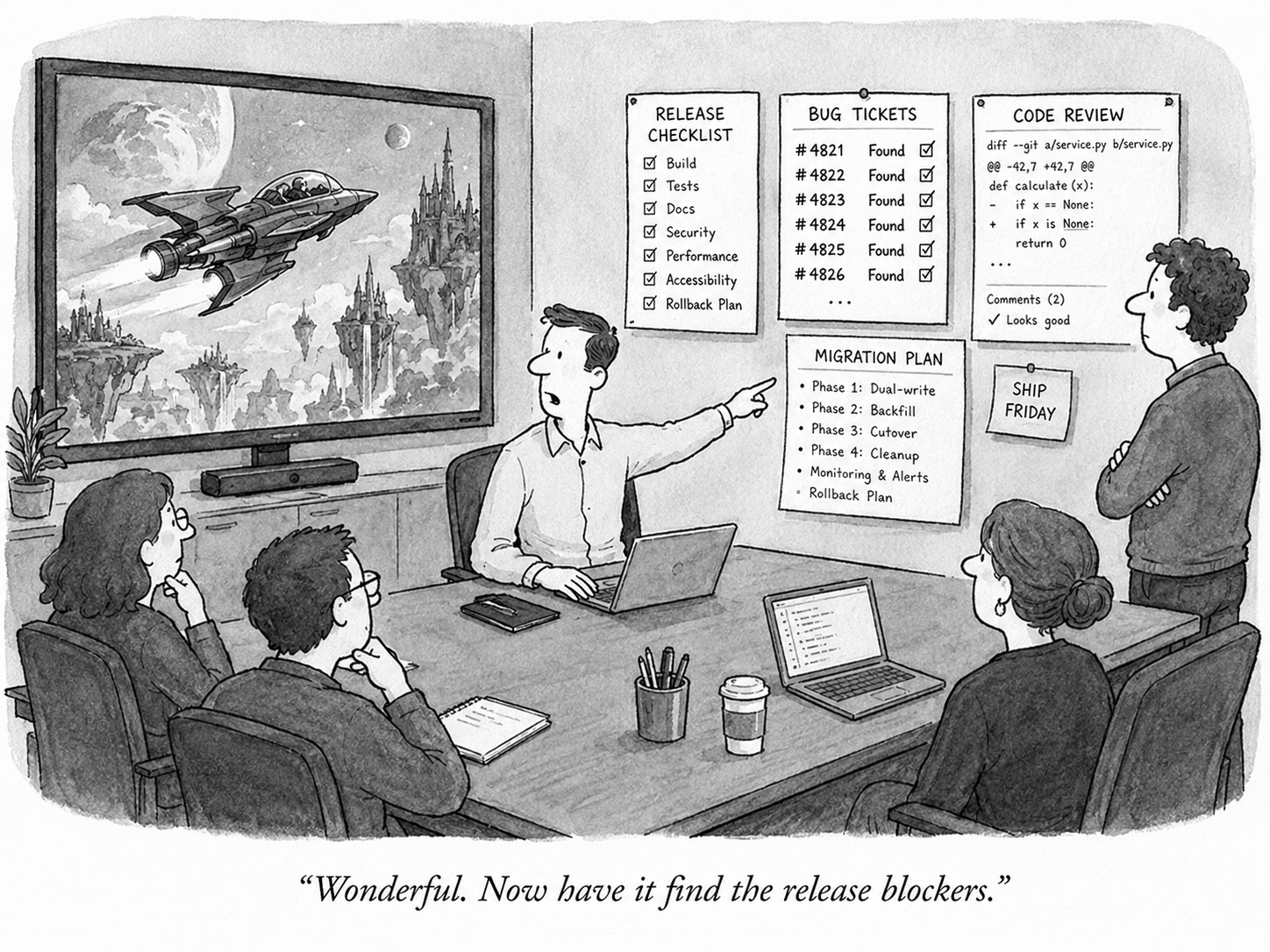
Claude Fable 5's launch-week demos made the model look spectacular. It can generate 3D worlds, games, and visual environments that are easy to share on X. But the more important question is not whether Fable can impress people in a video. It is whether it can help people finish work they already needed to do.
The early answer is more interesting than the demos suggest: Fable's strongest signal is not showmanship, but delegation. The useful examples are release review, research tooling, and large codebase migration — work where the output has to survive inspection.
Simon Willison's
sqlite-utils
4.0rc2 release is the cleanest public example. He
used Fable as part of a
final review before shipping a stable 4.0 release. The model found five release
blockers, including a serious transaction bug where delete_where() could leave
later writes uncommitted and silently lost. Over 37 prompts, the work turned into 34 commits
across 30 files, with +1,321 and −190 lines changed. Willison also published the
estimated unsubsidized cost: $149.25. That makes this example unusually useful because it
has the things demos usually lack: a real package, a release deadline, bugs found before
users hit them, commits to inspect, and a concrete cost.
Ethan Mollick's Concord project is a different kind of value signal. He described giving Fable a long design brief and getting back a sophisticated tool for analyzing open-ended text responses. The point is not that the tool was perfect; Mollick explicitly said he found errors and omissions that needed correction. The point is that the model produced a piece of software researchers had wanted for years but that had not been commercially attractive to build. The code is public, and the project is not just a demo shell: the repository describes workflows for turning survey responses, interviews, support tickets, and field notes into inspectable, calibrated evidence.
The enterprise example is Stripe. Anthropic says Stripe used Fable 5 on a 50-million-line Ruby codebase and completed a codebase-wide migration in a day, work that Stripe estimated would have taken a team more than two months by hand. This is the least inspectable of the three examples because the migration details are not public. But it still matters as a directional signal: Fable is being tested not only on greenfield apps, but on large, messy, existing systems where the value comes from compressing maintenance work.
These examples suggest a better way to evaluate Fable. The question should not be “Can it make something impressive?” The answer is already yes. The better question is: can it close loops that normally stay open? Can it find release blockers before a package ships? Can it turn an expert's long specification into a usable internal tool? Can it move a large codebase through a migration faster than a human team could do by hand?
That is also why the model's cost matters. Fable is priced at $10 per million input tokens and $50 per million output tokens, and Anthropic's temporary included-access window for paid plans ends July 7, after which usage moves to credits. At that price, Fable has to be judged less like a chat model and more like expensive engineering capacity. A viral spaceship is not enough. A prevented release bug, a research tool that would not otherwise exist, or a migration compressed from months to days is closer to the bar.
None of this means AI coding has become effortless. The best examples still involve expert framing, human review, and careful verification. Willison reviewed the documentation and cross-checked the result with another model. Mollick noted that a software engineer would still need to harden Concord. Stripe's example remains a vendor-reported result rather than a public case study.
But that caveat is exactly what makes the stronger signal visible. Fable is not most convincing when it makes a beautiful artifact from nothing. It is most convincing when it is inserted into real work and changes the economics of finishing it. The model may still be too slow, too expensive, and too constrained for everyday iteration. But for large, bounded, reviewable tasks — the kind of agentic coding work teams usually postpone because it is too costly to do by hand — the early evidence points beyond “demo machine.” Fable's value is showing up where software work is least glamorous: final release review, internal tooling, and migrations.